Why do brazilians need to talk about hygiene in later life? And why does the rest of the world?
30 April, 2026
This RGHI project is the first-ever funded study examining how older people in low- and middle-income countries are affected by hygiene issues. In fact, this issue attracts little attention in high-income countries. There are no existing systematic reviews on hygiene in later life, so we conducted our own. Yet even including high-income countries, we were only able to find 10 studies (1). There were none for Brazil. Does this lack of research mean that older people’s hygiene is unimportant? We suspected not, and our preliminary findings more than confirmed this.
Our fieldwork looks at hygiene experiences of older people living in slum neighbourhoods in different Brazilian cities. We have been struck by a number of issues.
- Many older people have limited mobility or other impairments. They have little access to adaptive technology and live in homes completely unsuited to bathing or hygiene. Consequently, maintaining body hygiene represents a big, often insurmountable, challenge. This has large effects on their health, well-being, and sense of dignity.
- Older people in deprived settings cannot afford private care and rarely have access to public services. When they need help with bathing and hygiene, this must come from family members. But these family members, usually women, struggle to perform this role. For example, many suffer injuries caused by lifting a heavy adult. Giving and receiving intimate care is often perceived as shameful and embarrassing.
- Problems with continence are widespread, but many older people struggle to manage this condition. For example, few can easily afford daily changes of incontinence pads without cutting back on other essential purchases. When combined with difficulties in bathing, this can lead to dangerously inadequate hygiene, which also puts other family members at risk.
Clearly, these issues are already having major impacts on the health and well-being of large numbers of people: older adults, caregivers and other family members. And these numbers are growing quickly, due to rapid population ageing.
This motivated us to organise a high-level national stakeholder event in São Paulo on 1 June. The event was not included in the original project, but RGHI kindly agreed to offer additional support. We are running the event in partnership with ABIHPEC, a Brazilian not-for-profit supported by the country’s main producers of hygiene products. The plan is to bring together stakeholders from relevant government agencies, civil society, the private sector and academia with a view to creating a national action network.
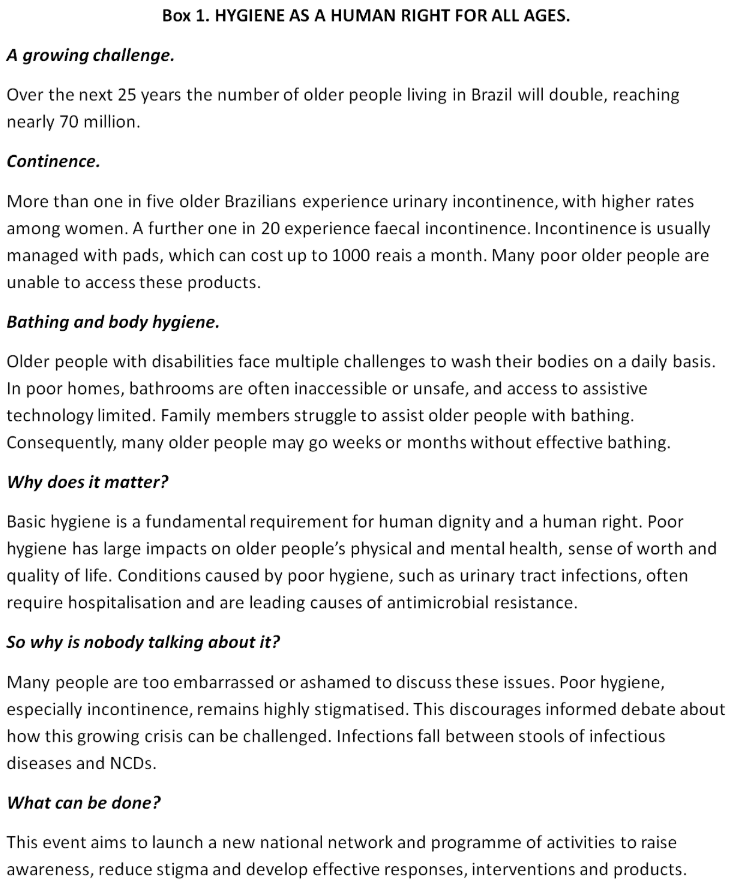
The event has already drawn in speakers and participants from across Brazil, including from the federal government and the Pan-American Health Organisation (WHO’s office for the Americas). The image (Box 1) contains a translated version of our publicity material.
Hopefully, this event will be a catalyst for significant action. Perhaps Brazil can lead the world in addressing this egregiously neglected issue.
If you would like more information about the event (before or after it takes place), please contact peter.lloyd-sherlock@northumbria.ac.uk
(1) These do not include studies which looked exclusively at oral hygiene in later life.
Peter Lloyd-Sherlock (RGHI Fellow), Larissa Pedreira & Roberta Pereira Góes


 Malaysian street food on display by jandrielombard (iStock Content Licence Agreement https://www.istockphoto.com/legal/license-agreement)